Best grammar and spell checkers in 2026
Writing error-free content is essential, whether you’re a student, a professional, or a content creator. A misplaced comma or a misspelled word can weaken your message and credibility. Fortunately, with the rise of AI and natural language processing technologies, the best grammar and spell checkers today do much more than catch simple typos. They help improve tone, structure, and even suggest better phrasing. In this article, we’ll explore the best grammar checker free tools, top spell checkers, and combined writing assistants that can make your writing shine.

What are grammar checkers?
Grammar checkers are software tools designed to analyze your text and identify grammatical errors. Their functionality extends beyond just catching subject-verb disagreements. Modern AI grammar checkers detect improper punctuation, awkward phrasing, stylistic issues, and even tone inconsistencies. The best grammar check tools now leverage machine learning to provide context-aware suggestions.
Key benefits:
- Corrects grammar mistakes in real time
- Enhances sentence structure and readability
- Offers tone and clarity suggestions
- Ideal for language learners and professionals
Spelling checkers explained: How they improve your text
Spell checkers are digital tools that identify and correct misspelled words. Unlike grammar checkers, spell checkers focus exclusively on word accuracy. They typically underline incorrect words and suggest alternatives from a dictionary database. While this might seem basic, spell checkers play a crucial role in avoiding embarrassing typos and improving clarity.
How they work:
- Compare typed words against a predefined dictionary
- Highlight unrecognized words
- Suggest correct spellings or alternatives
Grammar check vs. Spell check: Understanding the difference
Though grammar and spell check tools serve different purposes, they often work hand in hand. Grammar checkers handle sentence-level issues, while spell checkers focus on word-level corrections. Many modern writing assistants combine both features into a single tool for user convenience.
Grammar checkers
- Focus on sentence structure and syntax
- Suggest tone and clarity improvements
Spell checkers
- Detect misspelled words
- Offer dictionary-based corrections
Combined Tools integrate both to provide a comprehensive writing assistant that ensures accuracy and professionalism.
Best grammar checkers
1. Grammarly

Grammarly is arguably the most popular AI grammar checker on the market. It offers real-time grammar, spelling, and punctuation correction along with advanced features such as tone detection and clarity improvements. Grammarly is available as a browser extension, desktop app, and mobile app, making it highly versatile. The AI engine behind Grammarly is constantly learning, offering increasingly nuanced suggestions for better writing. The premium version unlocks features like plagiarism detection and full-sentence rewrites. Whether you’re writing an email or crafting a blog post, Grammarly ensures your content is polished and professional.
Pros: Advanced grammar and tone suggestions, real-time corrections, browser integration
Cons: Premium version required for full features
Best for: Students and content creators
2. ProWritingAid

ProWritingAid is a comprehensive writing assistant geared toward in-depth editing. It analyzes your text for grammar, style, and structure, offering detailed reports and suggestions. Unlike other tools, it gives visualizations of sentence length, passive voice, and overused words. While it can seem overwhelming due to the sheer amount of data it provides, it’s incredibly useful for authors and long-form writers who want to refine every aspect of their prose. It also integrates with tools like MS Word, Scrivener, and Google Docs.
Pros: Detailed writing reports, in-depth grammar checks
Cons: Can be overwhelming for casual users
Best for: Authors and long-form writers
3. LanguageTool

LanguageTool is an open-source grammar checker that supports over 25 languages. It is ideal for multilingual users and integrates seamlessly with platforms like ONLYOFFICE. LanguageTool uses AI to provide grammar, punctuation, and style suggestions and includes a built-in synonym finder. While not as polished as premium tools, it’s a great free alternative that respects user privacy. It is also particularly useful for non-English content, making it a favorite among international teams.
Pros: Open-source, multilingual support, integration with ONLYOFFICE
Cons: Slightly less accurate than premium tools
Best for: Multilingual users
4. Hemingway Editor

The Hemingway Editor focuses on clarity and readability. It highlights complex sentences, passive voice, and adverbs to help make your writing more concise and impactful. While it lacks the robust grammar-checking capabilities of other tools, it’s excellent for writers who want to improve their style and engage readers better. The desktop version works offline, which is handy for writers working without a stable internet connection. Hemingway is not a traditional grammar checker, but it’s a valuable companion for self-editing.
Pros: Highlights readability issues
Cons: Doesn’t detect basic grammar errors
Best for: Bloggers, storytellers
5. Ginger

Ginger is a solid grammar and spell checker with added features like a text reader and translation for over 40 languages. It’s particularly helpful for ESL (English as a Second Language) users thanks to its intuitive interface and contextual grammar suggestions. Ginger also includes a sentence rephraser and a personal trainer that helps users learn from their mistakes. While the UI isn’t as polished as others, it remains a reliable tool for quick grammar fixes and writing improvement.
Pros: Grammar and translation tool
Cons: UI less intuitive
Best for: ESL users
6. Paperpal
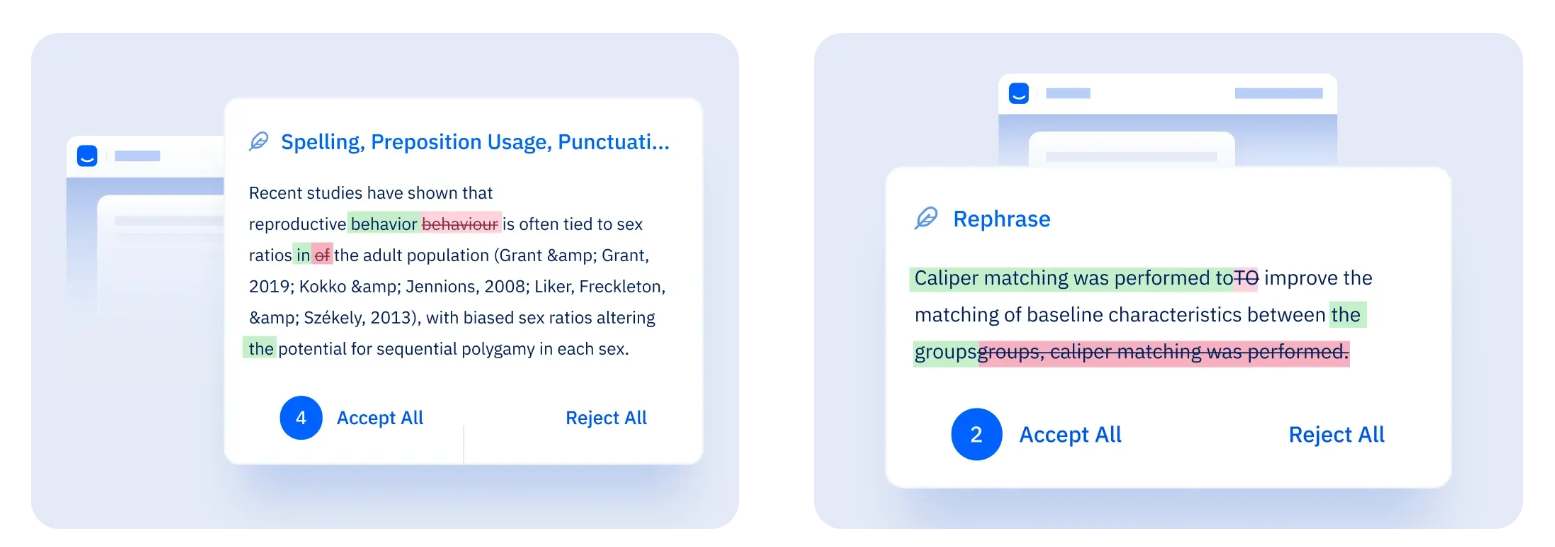
Paperpal is an intelligent grammar and writing checker designed primarily for researchers, university students, and anyone producing scientific or formal texts. Not only does it focus on spelling and grammar corrections, but it also offers style suggestions, contextual synonyms, and guidance for expressing complex ideas clearly. The tool is built to catch nuanced errors that generic grammar tools may miss, including specialized terminology and technical jargon.
The free version covers basic grammar and style checks, but premium plans offer deeper corrections and advanced features tailored for academic publishing.
Pros: Strong grammar and style corrections for academic and scientific writing.
Cons: The free version is limited and the tool is mainly focused on formal or academic texts.
Best for: Anyone writing academic or scientific content.
7. Trinka AI
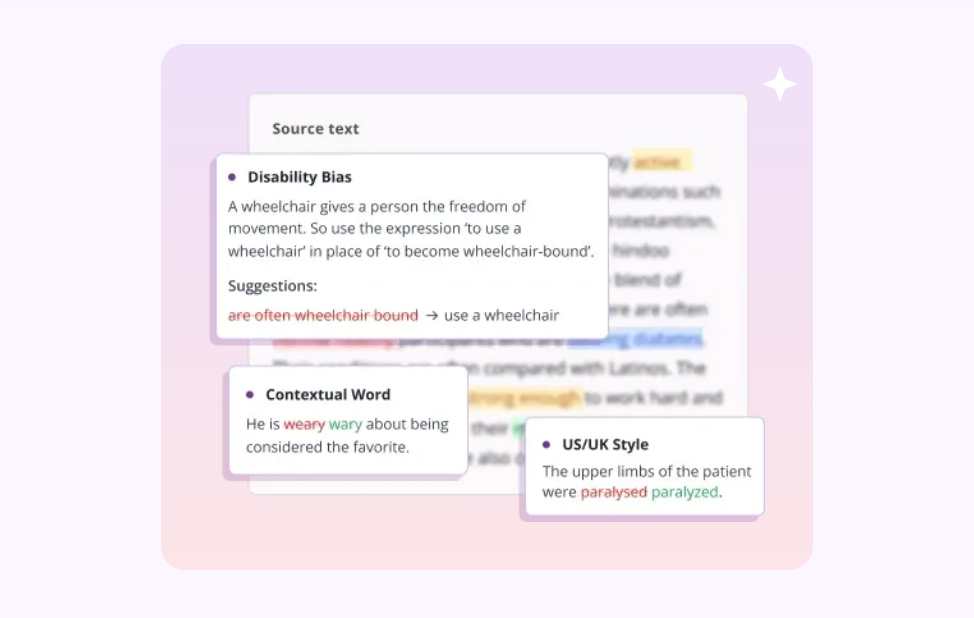
Trinka AI is an advanced grammar checker that goes beyond spelling and basic grammar to improve sentence structure, tone, and word choice. Its AI is trained on formal and technical documents, making it well suited for scientific articles, reports, business documents, and professional writing.
In addition to grammar and spelling corrections, Trinka analyzes sentence flow and clarity, adapting suggestions for academic or professional audiences and supporting both American and British English. It also offers plagiarism checking, LaTeX corrections, and automatic citation formatting.
Pros: Advanced corrections for formal writing; support for plagiarism checks, LaTeX editing, and citation formatting.
Cons: Free version has strict word limits and most advanced features require a paid plan. Available in a few languages.
Best for: Professionals working on technical or scientific documents.
Best spell checkers
1. Microsoft Editor

Microsoft Editor is integrated into Microsoft Word and Outlook and available as a browser extension. It checks spelling, grammar, and style in real-time. The tool leverages Microsoft’s AI to deliver contextual suggestions, and the premium version offers even more advanced features, such as similarity checks and style critiques.
Pros: Built into Office, accurate suggestions
Cons: Requires Microsoft account
Best for: Business and academic users
2. Hunspell

Hunspell is a powerful open-source spell checker used in many software applications, including LibreOffice and Firefox. It supports complex languages and morphological analysis, making it suitable for software developers and localization teams. Custom dictionaries can be added to enhance its functionality. Although it requires technical skills to implement, Hunspell is a robust tool for advanced users.
Pros: Open-source, customizable
Cons: Requires technical knowledge
Best for: Developers, localization teams
3. Scribens
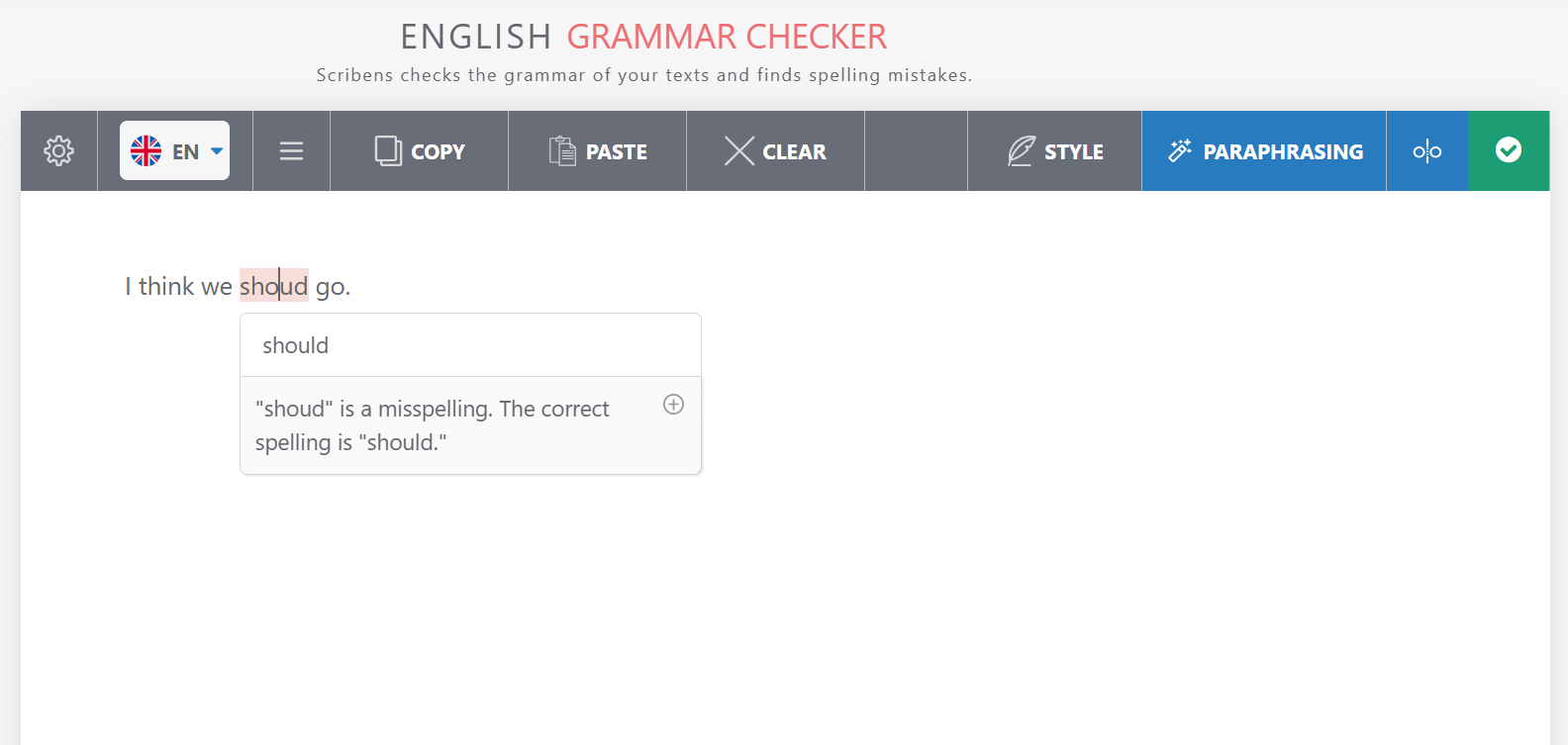
Scribens is primarily a spell checker with additional grammar-checking capabilities used for quick reviews, supporting over 30 languages. It detects common errors such as verb conjugation issues, agreement mistakes, punctuation problems, and syntax errors, often with clear explanations. Scribens works in the browser and via extensions for Chrome, Google Docs, and Microsoft Word, and also offers basic paraphrasing and synonym suggestions. Premium plans remove daily limits and support longer texts.
Pros: Free and easy to use; multilingual support; clear explanations for corrections.
Cons: Limited advanced style suggestions and daily text limits in the free version.
Best for: Quick checks for students and everyday writing.
AI solution for collaborative editing
Many writing assistants—like Grammarly, ProWritingAid, LanguageTool, and Microsoft Editor—offer real-time grammar, spell, and style suggestions for everyday users, students, and professionals. For more advanced needs, ONLYOFFICE Docs provides a collaborative suite with editors for text, spreadsheets, presentations, and forms, plus a built-in AI assistant for grammar and spell checking, text summarization, translation, tone adjustment, and rewriting.
Users can also choose the most suitable provider for each task, giving them more control and reliable results.
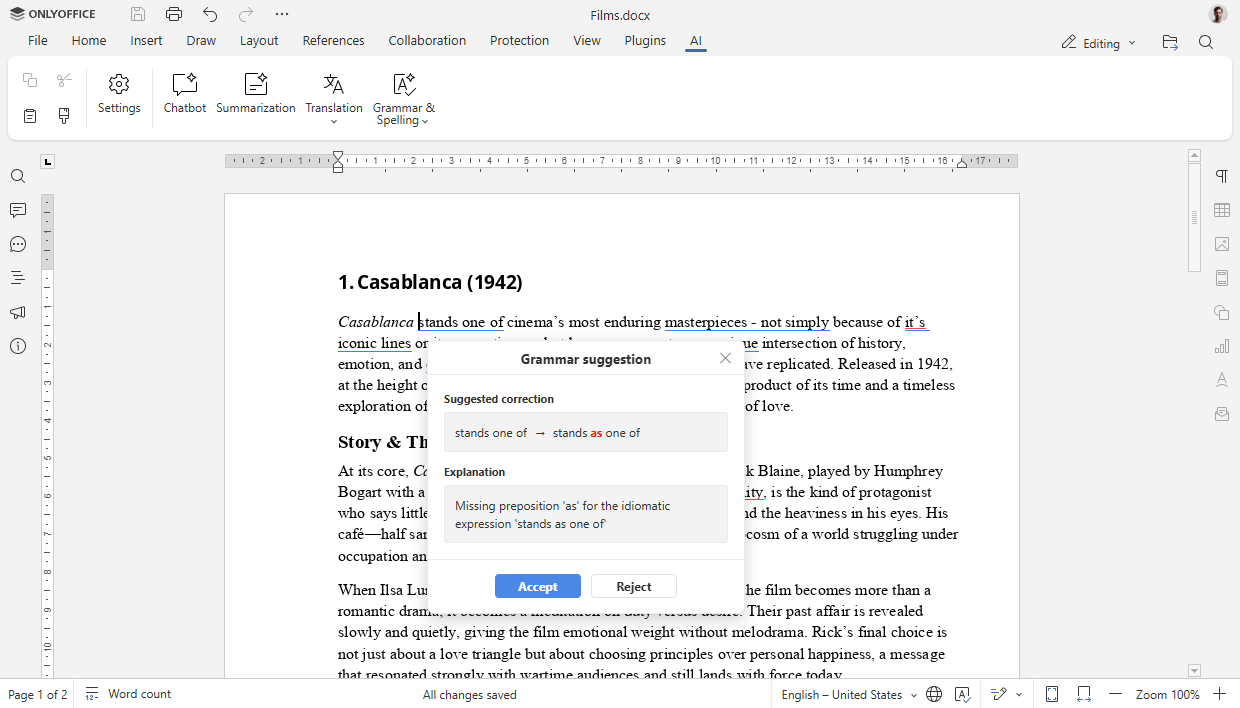
With its powerful combination of collaborative tools and customizable AI capabilities, ONLYOFFICE Docs offers a robust, all-in-one workspace for creating high-quality content with ease.
Pros: Fully integrated into ONLYOFFICE Docs, includes ChatGPT-powered features
Cons: Must be used in ONLYOFFICE suite
Best for: Teams using office suites, collaborative editing
Choosing the right writing assistant for your needs
Selecting the best grammar and spell check tool depends on your writing context. If you need real-time suggestions across apps, Grammarly is a solid choice. Authors will benefit from the detailed insights of ProWritingAid. For multilingual content, LanguageTool offers great support. Microsoft Editor is best suited for users already embedded in the ecosystem. If you’re using collaborative suites, the AI assistant in ONLYOFFICE is unbeatable in integrating grammar and spell checking with powerful AI tools.
Create your free ONLYOFFICE account
View, edit and collaborate on docs, sheets, slides, forms, and PDF files online.