Do you remember 2009 SaaS tools? Celebrating 16 years of ONLYOFFICE
This year, ONLYOFFICE turns 16. To mark the occasion, we’re publishing a series of 16 articles that trace the journey from a small team with a big idea to the office applications used by millions today. This is article one, and it starts where everything started: 2009.
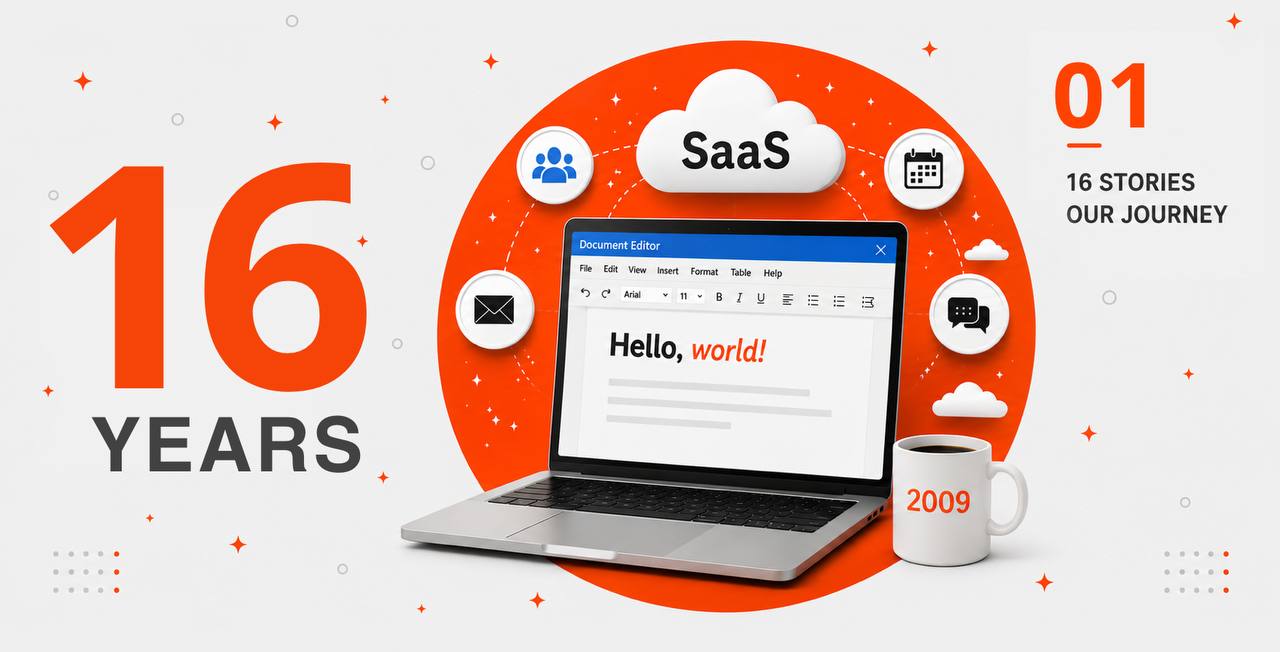
Think back to that year. Smartphones were still finding their feet, “the cloud” sounded like marketing jargon, and most teams still passed documents around as email attachments named final_v2_REALLY_final.doc. It was a strange in-between moment. Online work was clearly coming, but the tools to support it hadn’t quite caught up.
That gap is exactly where the story of ONLYOFFICE begins. Back then it wasn’t called ONLYOFFICE at all. It was TeamLab, a young project built to answer a simple question: why is working together online still so hard?
Here’s how it started, what the software landscape looked like at the time, and how the editors evolved from those early days into what they are in 2026.
What “online tools” meant in 2009
To understand why TeamLab was born, it helps to remember how teams actually worked back then.
Most collaboration happened through a patchwork of disconnected tools. You might keep tasks in one place, files on a shared drive, conversations in email, and documents on individual desktops. Nothing talked to each other. Version control meant renaming files and hoping for the best.
The term SaaS (software as a service) was already in use, but it still felt new to many businesses. Running important work “in the browser” raised eyebrows. Companies worried about reliability, control, and where their data actually lived.
A few patterns defined the era:
- Desktop-first habits. Serious documents were created in installed software, then shared as attachments.
- Tool sprawl. Project management, file storage, and communication lived in separate products that rarely connected.
- Email overload. The inbox became the default place for everything: approvals, files, updates, and discussions.
- Cautious cloud adoption. Plenty of teams were curious about online tools but unsure whether to trust them.
The appetite for something better was real. People could feel that scattered tools were slowing them down, even if they couldn’t name the problem yet.
Which SaaS tools were available back then?
If you were online back then, some of these names will bring back memories. Here are some SaaS and cloud services that were shaping the early days of online work:
- Salesforce
- Google Apps
- Basecamp
- Dropbox
- HubSpot
- GoToMeeting
- Yammer
- Amazon Web Services (AWS)
Looking at this list, it’s clear the groundwork for modern teamwork was already being laid.
The problem teams kept running into
If you worked on a team around 2009, this scenario probably sounds familiar.
Someone starts a document and emails it to three colleagues. Each person edits their own copy. Now there are four versions, none of them complete, and someone has to manually merge the changes. Meanwhile the related tasks are tracked somewhere else entirely, and half the relevant decisions are buried in an email thread no one can find.

The core issue wasn’t a lack of tools. It was that the tools didn’t fit together. Collaboration was treated as an afterthought, something bolted on rather than built in.
Teams needed a single space where they could manage projects, share files, and stay in sync, without bouncing between five different products. That need is what gave TeamLab a reason to exist.
Why TeamLab was created
TeamLab started with a focused idea: bring the scattered pieces of teamwork into one connected place online.
Rather than building yet another standalone tool, the goal was to combine the essentials of collaboration such as projects, documents, and communication into a single platform that teams could use through the browser. The aim was to reduce friction. Less switching between apps. Fewer lost files. Less time spent managing work instead of doing it.
This was an ambitious bet for the time. Asking teams to move their work online took trust, and many were still cautious about the cloud. But the direction was clear: work was becoming more distributed, more digital, and more collaborative, and the software needed to match that reality.
Then vs Now: What the platform looked like at the beginning
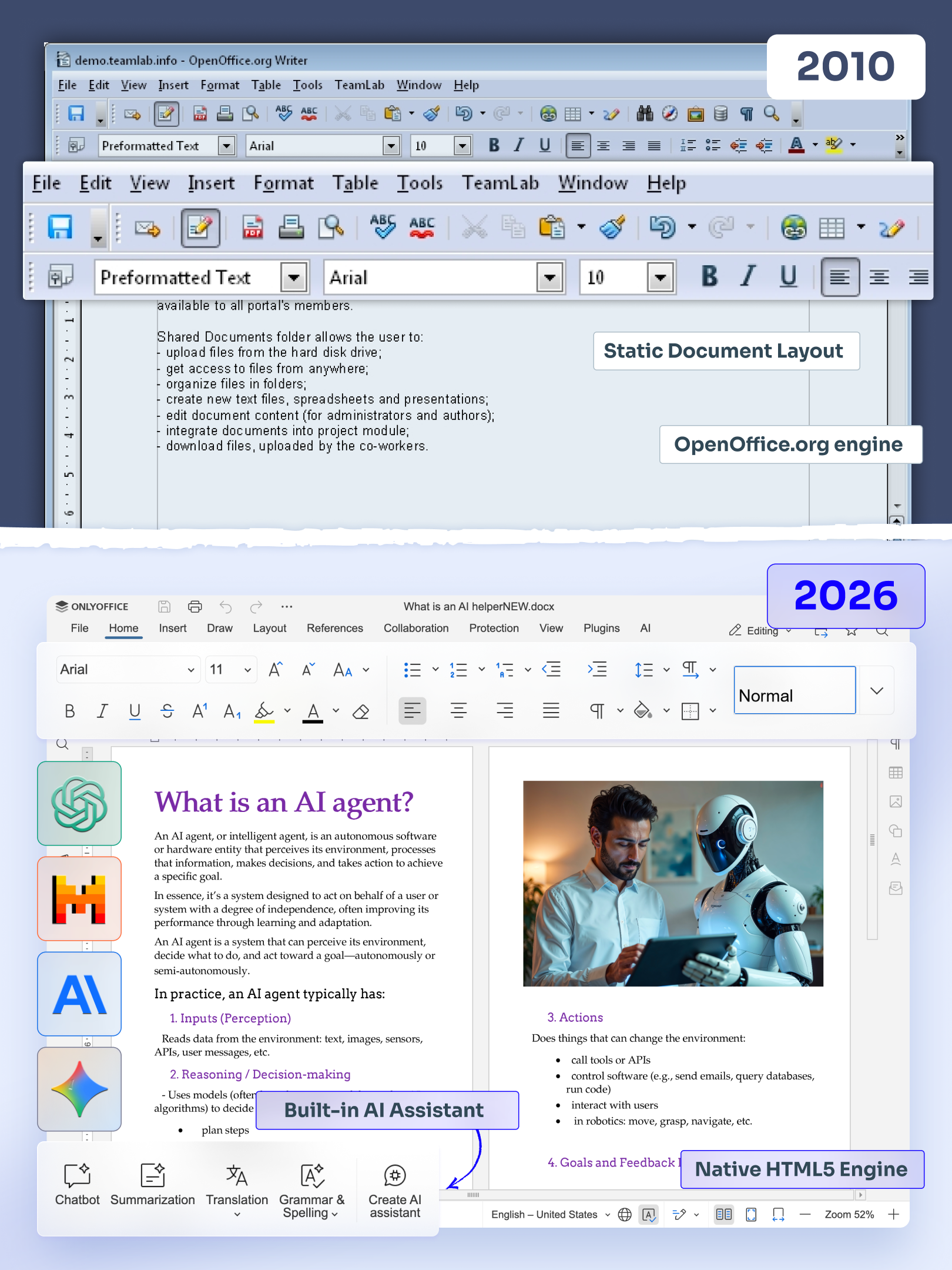
The earliest document editing experience inside TeamLab was a long way from what you’d expect today. In 2010, documents didn’t open in the browser at all. They opened in OpenOffice via a downloaded plugin and were saved back to the portal after editing. It worked, but it added steps, required software on every machine, and made the experience feel more like a workaround than a product.
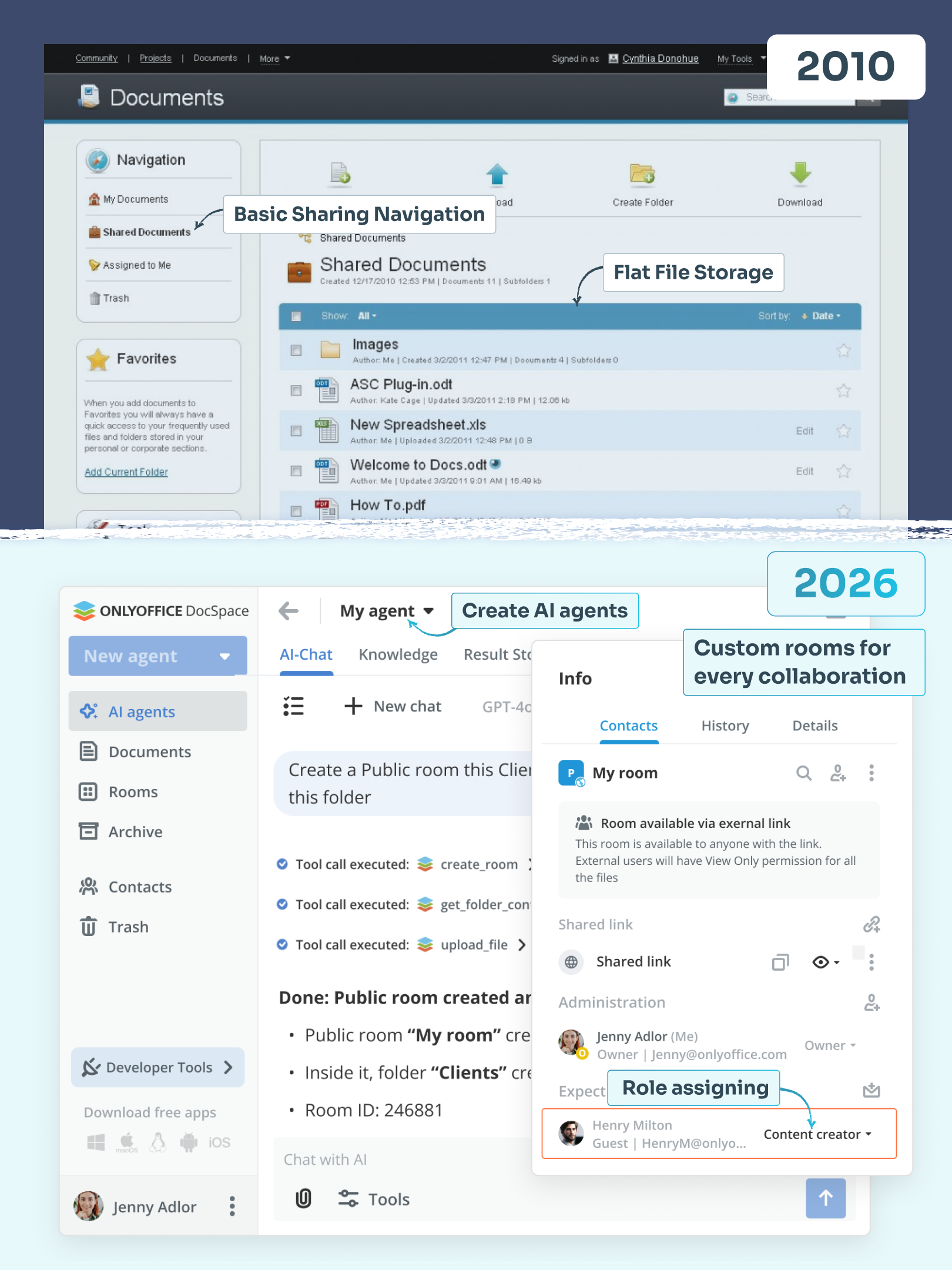
Document management in those early years was similarly straightforward: storage and basic sharing with colleagues. Useful, but far from the structured, permission-driven collaboration spaces that came later.
From TeamLab to ONLYOFFICE
Over time, TeamLab grew well beyond its first form. As online document editing matured, the platform leaned into one of the hardest and most valuable parts of teamwork: working on documents together, in real time, in the browser.
That evolution eventually led to the rebrand to ONLYOFFICE – a name that put the office documents front and center. What began as a way to organize projects and files became a full collaboration suite, with powerful editors at its core.
The throughline from 2009 to today is consistent. The goal has always been to remove the friction between people and their work, and to do it without forcing teams to stitch together a dozen disconnected tools.
Fun fact: 2009 or 2010?
You might be wondering why we keep mentioning 2009 in this article instead of 2010. Here’s the simple story behind it.
Back in 2009, we founded our company and rolled up our sleeves to start building our product. Then, in 2010, we officially launched it to the world as TeamLab, the project that would later grow into ONLYOFFICE.
So in 2026, we get to celebrate two milestones: 16 years of our product and 17 years since the company first came to life. Two birthdays, one happy team!
A journey through SaaS trust
The SaaS world of 2009 was full of promise and full of gaps. Teams could sense that online collaboration was the future, but the tools still made simple things harder than they needed to be. TeamLab set out to close that gap, and the journey from a small teamwork-focused project in 2010 to a fully integrated, AI-powered collaboration platform in 2026 shows just how far that original idea has come.
And do you trust SaaS services? Take a moment to think back: what was your very first cloud solution? Share your story in the comments or on social media, and don’t forget to tag us.
This is just the beginning
This article is the first in our 16-part series marking ONLYOFFICE’s 16th birthday. Over the coming weeks, we’ll dig into the key milestones, product decisions, and moments that shaped what ONLYOFFICE is today. If you’ve been with us since the early days, there’s a lot to look back on. And if you’re new here, welcome! You’ve joined at quite a moment.
Stay tuned for article two!
Create your free ONLYOFFICE account
View, edit and collaborate on docs, sheets, slides, forms, and PDF files online.